What is Generative Engine Optimization (GEO)? The Future of GEO Explained
Table of Contents
Introduction
For years, digital marketing revolved around one goal: rank on Google.
- Then came voice search.
- Then featured snippets.
- Then AI-generated answers.
And now, we've entered the most disruptive phase yet: the Generative search era. In this era, users don't browse websites; they ask questions and get AI-generated answers instantly.
This is where Generative engine optimization (GEO) becomes critical.
What is Generative Engine Optimization (GEO)?
Generative engine optimization (GEO) is the process of optimizing content so that AI systems can:
- Understand your information accurately.
- Extract key insights.
- Trust your content as a reliable source.
- Include your brand in generated responses.
These AI systems include:
- Google AI Overviews
- ChatGPT
- Gemini
- Claude
- Perplexity AI
- Other generative search platforms
Make your brand visible in AI-generated search results
Why GEO is Becoming Essential in 2026
Search behavior has fundamentally changed:
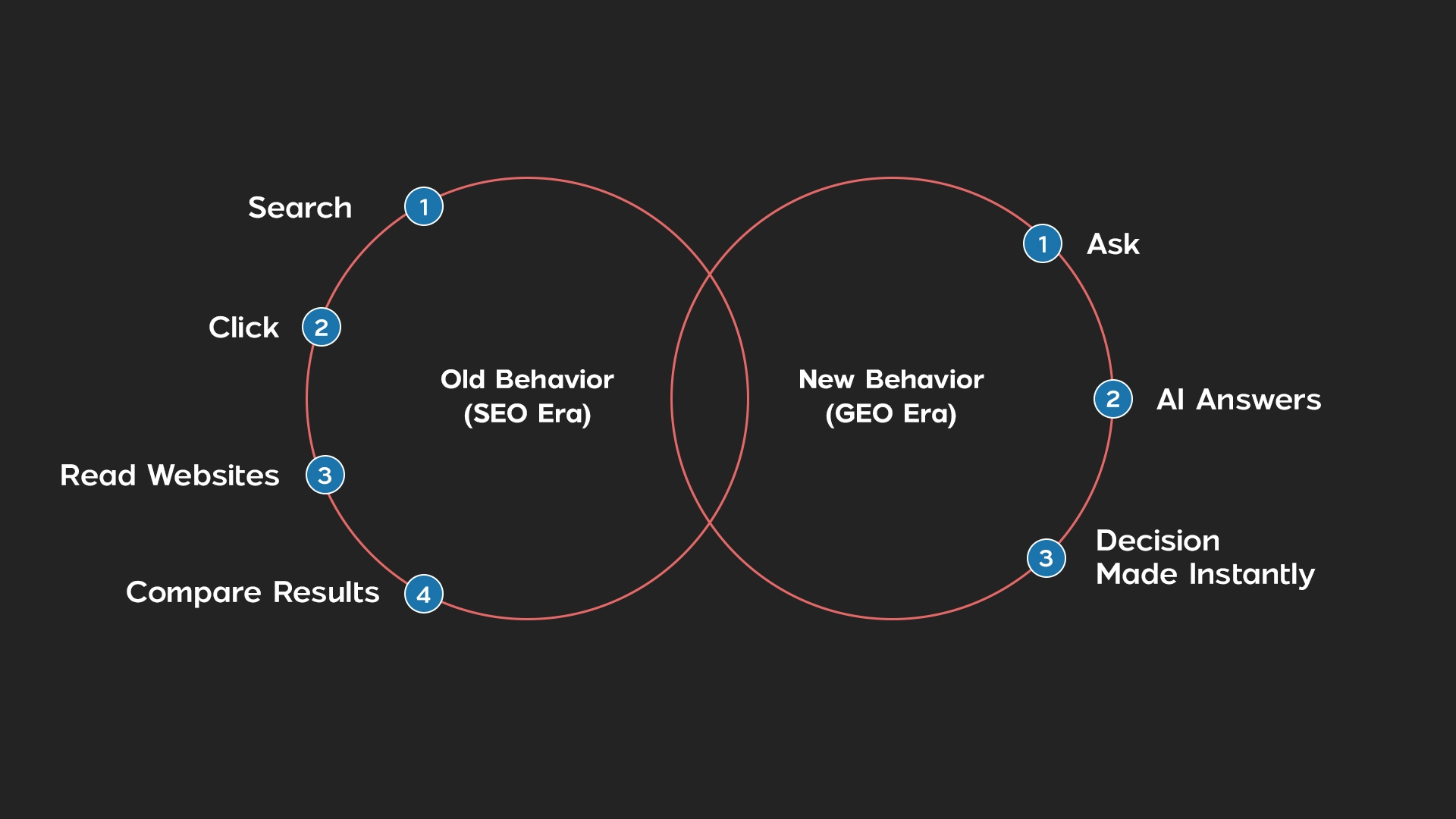
Key Industry Shifts:
- Rise of zero-click search experiences.
- AI is replacing SERP-based navigation.
- Users are trusting AI summaries over websites.
- Reduced organic click-through rates.
- Increased conversational search behavior.
The Core Reality: If AI doesn't mention your brand, users may never see you, even if you rank.
How do Generative Engines Work?
Unlike traditional search engines, generative systems don't rank pages. They construct answers dynamically.
Step 1: Data Collection
AI pulls information from:
- Websites
- Articles
- Knowledge graphs
- Structured data sources
Step 2: Content Interpretation
AI analyzes:
- Meaning
- Context
- Entities
- Relationships between ideas
Step 3: Response Generation
AI combines multiple sources into a single, human-like answer
Critical Insight: Even if your page is not shown, your content may still influence the final AI response.
Stay ahead in ChatGPT, Gemini & AI search ecosystems
Core Pillars of GEO
GEO is built on how AI evaluates content quality and relevance.
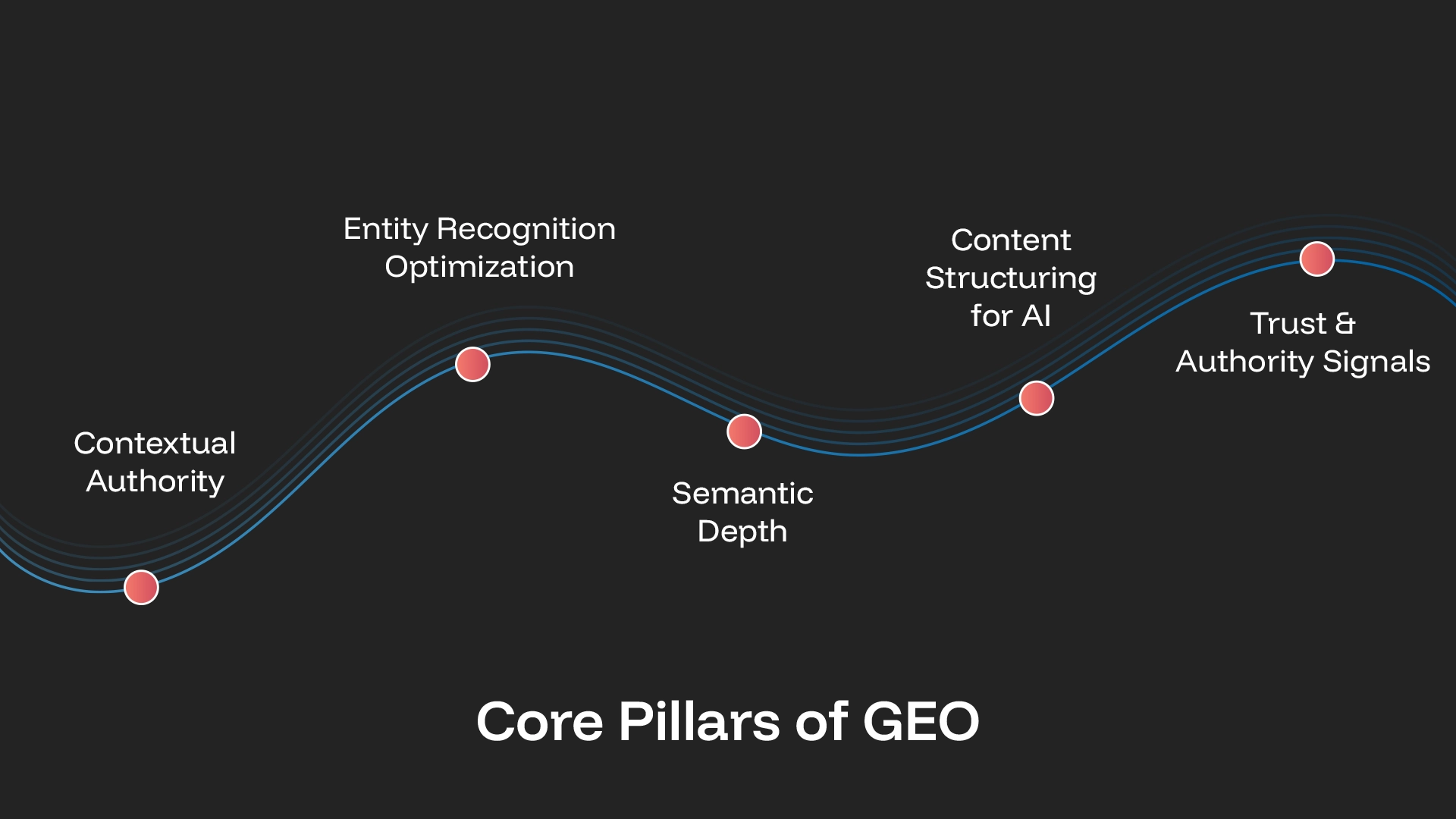
Contextual Authority
AI prefers content that fully explains a topic, not surface-level definitions.
Strong GEO content includes:
- What is it?
- Why does it matter?
- How does it work?
- Real-world applications.
Entity Recognition Optimization
AI systems think in entities, not just keywords.
Entities include:
- Brands
- Tools
- Concepts
- Services
- Locations
Clear entity presence improves AI association and visibility.
Turn your content into AI-cited authority assets
Semantic Depth
GEO is not keyword stuffing. It is topic completeness.
Strong GEO content includes:
- Related concepts
- Supporting ideas
- Industry connections
- Comparisons
Content Structuring for AI
AI prefers clean, structured information:
- Headings (H1–H3)
- Bullet points
- Tables
- FAQs
- Short, clear paragraphs
Structure improves machine readability and extraction.
Trust & Authority Signals
AI systems prioritize content that appears:
- Factually accurate.
- Consistent across sources.
- Expert-written.
- Regularly updated.
GEO vs SEO vs AEO
See how search optimization has evolved from SEO to AEO to GEO in today's AI-first digital landscape:
| Feature | SEO | AEO | GEO |
|---|---|---|---|
| Primary Goal | Rankings | Direct answers | AI-generated inclusion |
| Visibility Type | Search results | Featured snippets | AI responses |
| User Interaction | Click-based | Answer-based | Conversation-based |
| Optimization Focus | Keywords | Questions | Context + authority |
| Outcome | Traffic | Visibility | AI citation & influence |
Get ahead before AI search replaces traditional SEO
Why GEO is a Game-Changer for Businesses
GEO is reshaping digital marketing in multiple ways:
- AI-First Discovery: Users increasingly rely on AI tools instead of search engines.
- Reduced Dependence on Clicks: Visibility is no longer tied to website visits.
- Brand Authority Boost: Being cited by AI increases trust and credibility.
- Competitive Advantage: Early GEO adopters dominate AI-driven discovery channels.
Who Needs GEO the Most?
GEO is essential for:
- Digital marketing agencies
- SaaS companies
- E-commerce brands
- Healthcare providers
- Financial services
- Local service businesses
- Tech companies
Rule of Thumb: If your audience uses AI tools, you need GEO.
Your competitors are already adapting to AI search
How to Build a GEO Strategy (Step-by-Step Framework)
Use this framework to structure your GEO strategy for maximum impact in 2026:
Step 1: Build Topical Authority
Create multiple interconnected content pieces around your niche.
Step 2: Focus on Meaning, Not Keywords
Answer real questions:
- What is it?
- Why does it matter?
- How does it work?
Step 3: Strengthen Entity Presence
Ensure your brand is consistently:
- Mentioned
- Defined
- Contextually linked
Own the answer space in your industry
Step 4: Optimize Content Structure
Use:
- Clear headings
- FAQs
- Tables
- Lists
Step 5: Continuously Update Content
AI prefers fresh, evolving, and updated data.
The Future of GEO
The evolution of search is accelerating:
- AI will become the default search interface.
- Traditional blue links will reduce importance.
- Content will be judged by AI usability, not just rankings.
- Brands will compete for inclusion, not clicks.
Future Insight:
- Search engines are becoming answer engines.
- Answer engines are becoming generative engines.
- Generative engines are becoming decision engines.
Final Thoughts
Generative engine optimization is not just a digital marketing trend; it is a fundamental transformation of how information is discovered, processed, and delivered.
Brands that adapt to GEO will:
- Gain early AI visibility.
- Build stronger digital authority.
- Dominate next-gen search platforms.
- Future-proof their marketing strategy.
Those that ignore it will slowly fade from visibility, not because they disappeared, but because AI stopped mentioning them.
Make your brand the answer, not just another result